Before Hiring a Builder in London – Check These 12 Things

Before Hiring a Builder in London - Check These 12 Things

Over the years, I’ve received countless calls from homeowners across London who found themselves in serious trouble halfway through a building project. In many cases, the story was similar: the builder had stopped answering calls, work had been left unfinished, costs had spiralled out of control, or the quality of workmanship was far below what had been promised.

As a builder myself, I’ve visited properties where the situation was genuinely shocking. I’ve seen extensions built incorrectly, structural work completed without proper approvals, projects abandoned halfway through, and homeowners forced to spend thousands of pounds fixing mistakes that should never have happened in the first place. In some cases, entire sections of work had to be demolished and rebuilt, resulting in major delays and budgets being stretched far beyond what was originally planned.

The reality is that choosing a builder is much harder than it looks. Most people only undertake a major renovation, extension, or loft conversion once or twice in their lifetime. Without experience in the construction industry, it can be difficult to spot warning signs before it’s too late.

We’ve all heard stories about rogue builders, unfinished projects, and renovation nightmares. Unfortunately, these situations are more common than many homeowners realise. A poor choice can affect not only your finances but also your daily life, leaving you living in a building site for months longer than expected while trying to resolve disputes and find someone capable of putting things right.

In fact, these problems continue to make national headlines.

In 2026, the BBC reported on a family who paid their builder £44,000 for extension works, only to be left dealing with serious building defects, Building Control failures and a lengthy legal battle. The case ultimately resulted in criminal convictions under the Building Act, compensation awards and a suspended prison sentence for the contractor involved. Stories like this are an extreme example, but they highlight just how serious the consequences can be when the wrong builder is chosen.

One of the most common problems I encounter is hidden costs. A quote may look attractive at first glance because it appears significantly cheaper than others. However, many homeowners later discover that important items were never included, specifications were left vague, or additional charges appear throughout the project. What initially looked like the cheapest option often becomes the most expensive.

Another issue is what I call the “low-price builder trap”. Some builders secure projects with an attractive quote, only to charge extra for every variation, unexpected issue, or item that wasn’t clearly detailed from the start. In many cases, potential risks were never discussed during the quotation stage, leaving homeowners with unexpected bills later.

I’ve also seen homeowners face serious problems when work was completed without the correct Building Control inspections and sign-offs. These issues may not become apparent until years later when the property is being sold, refinanced, or surveyed, creating unnecessary complications and expenses.

Perhaps the most stressful situation of all is when a builder walks away from a project before completion. Finding a new contractor willing to take over someone else’s unfinished work is rarely easy. Many builders are understandably cautious about inheriting existing problems, which can leave homeowners stuck with an incomplete project for months.

The good news is that most of these problems can be avoided. Before hiring a builder in London, there are several simple but essential checks that can help protect your budget, your property, and your peace of mind.

In this guide, I’ll walk you through the 12 checks every homeowner should make before signing a contract.
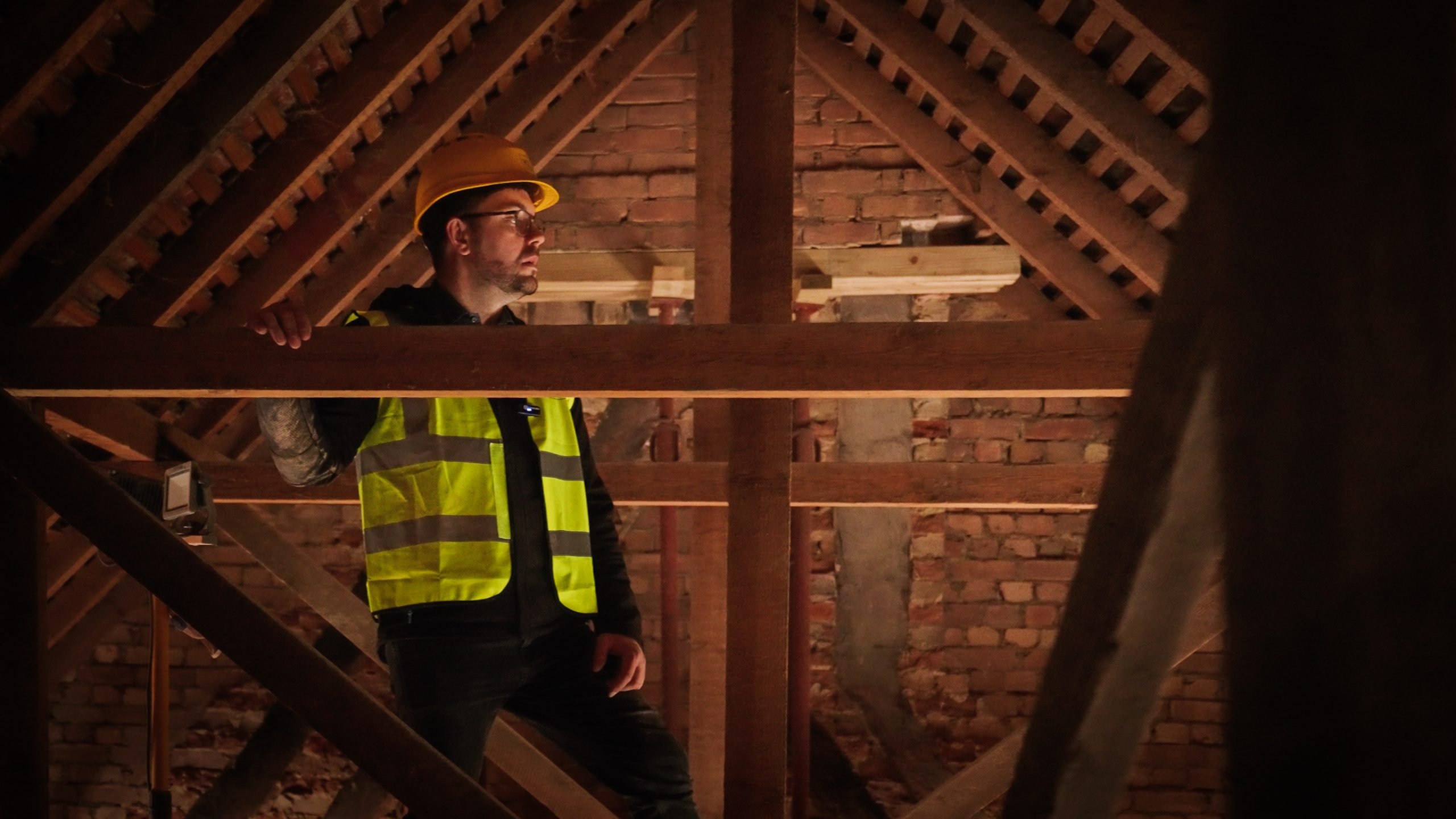
Marcin Kluk and Before Hiring a Builder in London

The Builder Hiring Checklist

In this article, we’ll go through our builder hiring checklist step by step and explain why each check matters before you commit to a contractor.

The list below is based on years of experience dealing with successful projects as well as helping homeowners recover from building projects that have gone wrong. We’ve arranged the checks from the simplest and quickest to complete through to the more detailed investigations that can save you from major problems later.

Once you have shortlisted a builder, I strongly recommend working through every point on this list before making your final decision. Spending a few extra hours carrying out proper checks could save you thousands of pounds and months of unnecessary stress.


Before Hiring a Builder in London, Check These 12 Things:


  1. Check that the builder is a legitimate UK business and how long they have been trading.

  2. Verify their insurance cover.

  3. Obtain a detailed written quotation.

  4. Review previous projects and case studies.

  5. Check independent reviews and ratings.

  6. Speak to previous customers.

  7. Visit completed projects where possible.

  8. Find out who will actually be carrying out the work.

  9. Confirm Building Control procedures and responsibilities.

  10. Understand the payment schedule and avoid excessive upfront payments.

  11. Never proceed without a written contract.

  12. Check what warranties and guarantees are provided.

1. Check that the builder is a legitimate UK business and how long they have been trading

Before considering quotations or project timelines, make sure you’re dealing with a genuine and established business.

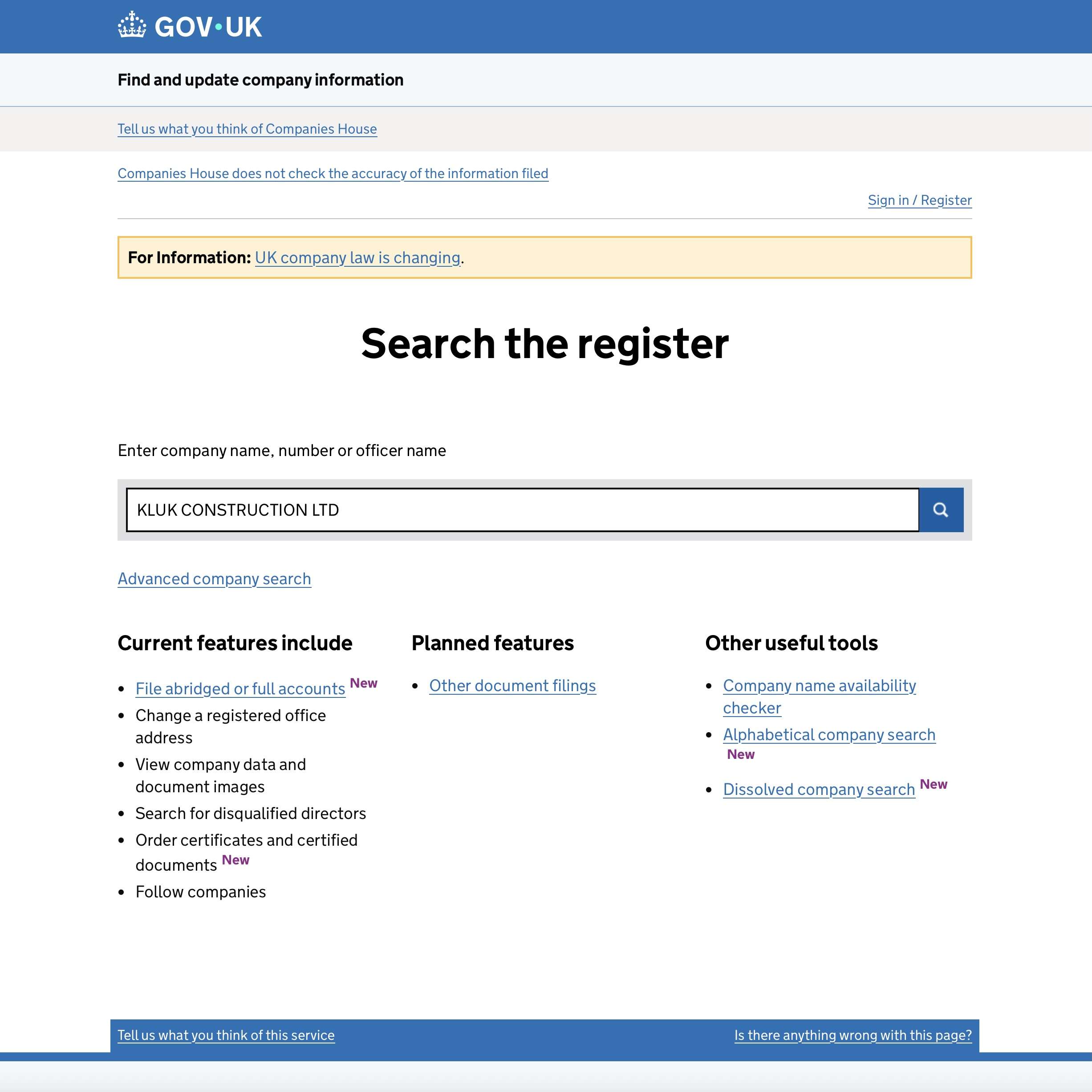
The first place to check is Companies House. Here you can see when the company was incorporated, who the directors are, and whether the business has a stable trading history.

For example: Kluk Construction Ltd.

While every company has to start somewhere, major refurbishments, extensions and renovations often involve significant budgets. A company that has been trading successfully for several years is generally a safer choice than a newly formed business with little proven history.

It’s also worth checking the director’s history, not just the current company. If a director has been involved with multiple construction companies that were dissolved, liquidated or ceased trading after a short period, this should raise questions. In our experience, some individuals repeatedly open new companies every few years, making it difficult for homeowners to assess their long-term track record.

Another useful check is VAT registration. At the time of writing, UK businesses must register for VAT once their taxable turnover exceeds £90,000 per year. Most companies undertaking major refurbishment and extension projects should comfortably exceed this threshold. While there can be legitimate exceptions, a lack of VAT registration may be worth discussing before proceeding.

Quick Checklist

✓ Check the company on Companies House

✓ Check how long the company has been trading

✓ Review the director’s history and previous companies

✓ Verify the registered business address

✓ Check whether the company is VAT registered

✓ Review the company’s website, portfolio and online presence

A few minutes of research can reveal a lot about the company you are trusting with your home and your money.

Company House Kluk Construction Ltd

2. Verify their insurance cover

Insurance is one of the most important checks you can make before hiring a builder, yet many homeowners never ask for proof of cover.

A reputable building company should have appropriate insurance in place to protect both their business and your property. If something goes wrong during the project, inadequate insurance could leave you facing significant financial costs.

At a minimum, ask for evidence of:

  • Public Liability Insurance
  • Employers’ Liability Insurance
  • Contractors All Risks Insurance (recommended for larger projects)

Don’t be afraid to ask for copies of insurance certificates and check that the policies are current. Professional builders will be used to these requests and should have no issue providing them.

It’s also worth checking the level of cover. A company carrying out major refurbishments, extensions, or structural alterations should have insurance appropriate to the scale of the work being undertaken.

Why This Matters

We’ve seen cases where accidents, water damage, structural issues, or damage to neighbouring properties have occurred during building works. Without proper insurance, disputes can quickly become complicated and expensive.

3. Obtain a detailed written quotation

A quotation should do far more than tell you the final price.

One of the biggest mistakes homeowners make is comparing builders based purely on the bottom-line figure. In reality, two quotes may look similar on price while covering completely different scopes of work.

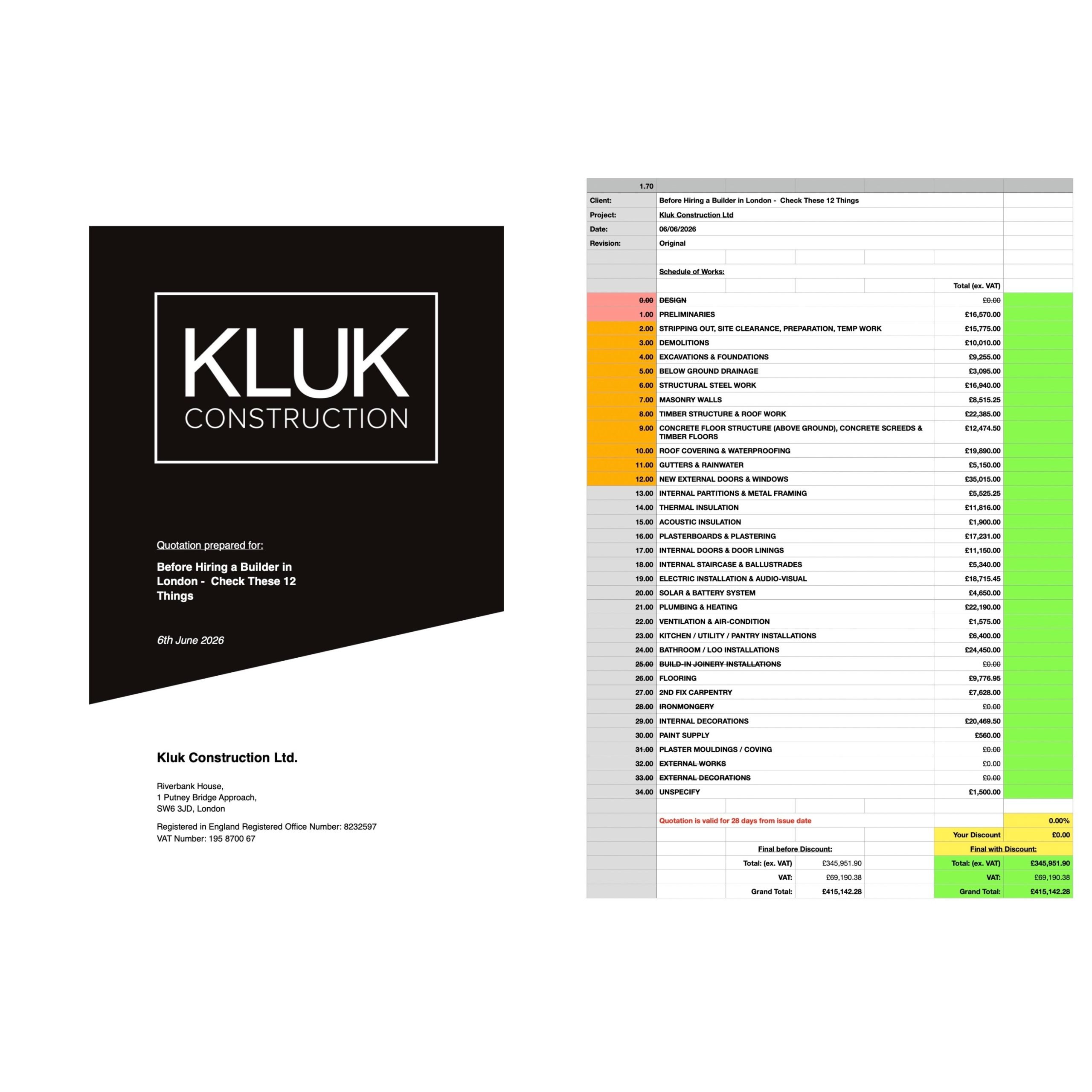
A professional quotation should be broken down into clear sections so you can understand exactly what is included within each stage of the project. For example, separate sections should cover areas such as preliminaries, demolition, structural works, insulation, plastering, electrical works, plumbing, bathrooms, flooring, decorating and finishing works.

Within each section, the builder should clearly explain the work being carried out, quantities where possible, any assumptions made, and any exclusions that may affect the final cost.

A good quotation should also clearly identify:

  • What is included
  • What is excluded
  • Potential risks or unknowns
  • Material specifications
  • Provisional sums or items still to be confirmed
  • Payment terms


If a quote consists of a few lines and a total figure, it’s very difficult to compare builders properly. More importantly, it’s difficult to identify what may have been left out.

Many building disputes start because homeowners believe something is included, while the builder believes it is not. A detailed quotation helps avoid these misunderstandings before work begins.

Our Advice

When comparing quotations, don’t ask “Which builder is cheapest?”

Instead ask:

“Which builder has clearly explained what I am paying for?”

The answer to that question will often tell you far more about the quality of the company than the final price alone.

Front cover of quotation prepare for residential refurbishment project in London by Kluk Construction

4. Review previous projects and case studies

Every builder can tell you they do high-quality work. The real question is whether they can prove it.

Before hiring a builder, ask to see examples of projects that are similar to your own. If you’re planning a loft conversion, look at loft conversions. If you’re undertaking a full refurbishment or extension, ask to see projects of a similar size and complexity.

Pay attention to more than just the finished photographs. A professional builder should be able to explain:

  • The scope of the project
  • The challenges encountered
  • How those challenges were resolved
  • The project timeline
  • The final outcome

Remember that social media often shows only the best angles and finished results. While photographs are useful, they don’t tell the whole story.

Look for builders who regularly document projects from start to finish. This demonstrates experience and gives you a better understanding of the standard of work you can expect.

What to Look For

✓ Projects similar to your own

✓ Before, during and after photographs

✓ Consistent quality across multiple projects

✓ Attention to detail in finishes

✓ Complex structural or refurbishment projects, not just cosmetic work

✓ Evidence that projects were completed successfully

A Word of Caution

Be wary of builders who only have a handful of professional-looking images on their website but cannot provide further details about the projects.

In today’s world, anyone can build a website and upload attractive photos. What matters is whether the builder has a proven track record of successfully delivering projects like yours.

The more expensive and complex your project becomes, the more important it is to see evidence that the builder has completed similar work before.

Call us now

For a free quotation

5. Check independent reviews and ratings

Independent reviews are a useful starting point when researching a builder, but they should never be the final deciding factor.

We recommend checking platforms such as:

  • Google Reviews
  • Checkatrade
  • Houzz

These platforms can provide valuable insight into a company’s reputation, communication, reliability and customer satisfaction.

However, homeowners should also understand that online reviews are a useful indicator, but they should never replace proper due diligence. A company may have excellent reviews, but that doesn’t necessarily mean they are the right fit for your specific project. The best way to verify a builder’s capabilities is to speak with previous clients and see completed projects in person.

That’s why we believe reviews should be treated as an initial screening tool rather than proof of quality.

What to Look For

When reading reviews, pay attention to:

  • How long the company has been collecting reviews
  • Whether reviews have been posted consistently over time
  • Detailed comments rather than one-line ratings
  • How the company responds to criticism
  • Mentions of communication, cleanliness, organisation and aftercare

Check Their Social Media Activity

Another useful step is to follow the builder’s social media accounts for a period of time before making a decision.

While social media shouldn’t replace proper due diligence, it can provide valuable insight into how the company operates on a day-to-day basis.

Look for:

  • Regular project updates
  • Ongoing construction work
  • Progress photos and videos
  • Behind-the-scenes site activity
  • Team members working on projects
  • Recently completed projects
  • Customer testimonials and handovers

A builder who consistently documents their work often has nothing to hide and is proud of the projects they deliver.

On the other hand, be cautious of accounts that only post highly polished marketing content, stock images, or have long periods with no activity. If a company claims to be completing multiple projects every year but rarely shows any ongoing work, it’s reasonable to ask why.

Social media won’t tell you everything, but it can help confirm that a builder is actively working, regularly delivering projects and maintaining a visible presence within the industry.


The Most Important Check

No online review is more valuable than speaking directly with a previous customer and seeing completed work with your own eyes.

A genuine builder should be comfortable introducing you to previous clients and showing projects they have completed. Walking through a finished project allows you to assess workmanship, attention to detail and overall quality in a way that no website, brochure or online review ever can.

In our experience, homeowners gain far more confidence from a 15-minute conversation with a previous client than from reading hundreds of online reviews.

Reviews are useful, but real customers and real projects tell the true story.

Before hiring a builder in London keep track of his social media activities

6. Speak to previous customers.

If a builder is unwilling to put you in touch with previous customers, you should ask yourself why.

Speaking directly with former clients is one of the most valuable checks you can make before hiring a builder. While websites, brochures and reviews can help you build an initial impression, nothing compares to hearing first-hand experiences from people who have already gone through the process.

A good builder should be able to provide references from recent projects similar to your own.

When speaking to previous customers, don’t just ask whether they were happy with the end result. Ask about the entire experience.

Questions Worth Asking

  • Was the project completed on time?
  • Was the final cost close to the original quotation?
  • How was communication throughout the project?
  • How were unexpected issues handled?
  • Was the site kept organised and secure?
  • Would you hire the builder again?
  • Did any problems arise after completion and, if so, how were they resolved?

Listen for the Details

The most useful conversations often happen when customers start sharing the small details that never appear in online reviews.

Did the builder turn up when promised?

Did they communicate well?

Were variations explained clearly?

Did they take responsibility when problems occurred?

These day-to-day experiences often tell you more about a builder than a portfolio of finished photographs.

Our Advice

If possible, ask to speak with at least two or three previous customers. The more conversations you have, the easier it becomes to identify consistent strengths and weaknesses.

7. Visit completed projects where possible.

If there is one check that can instantly separate a good builder from a great builder, it’s seeing their work in person.

Photographs, videos and online portfolios can be helpful, but they only show what the builder wants you to see. Visiting a completed project allows you to assess the quality of workmanship for yourself and notice details that rarely appear in photographs.

When viewing a completed project, pay attention to:

  • The quality of finishes
  • Straight walls and ceilings
  • Tiling and flooring details
  • Joinery and carpentry work
  • Decorating standards
  • General attention to detail

Look beyond the obvious features and focus on the smaller details. Often it’s the finishing touches that reveal the true standard of a builder’s work.

Why This Matters

Over the years, we’ve visited many properties where the photographs looked excellent, but the reality was very different. Small defects, poor finishing, uneven surfaces and rushed workmanship are often difficult to spot in carefully selected marketing images.

A completed project allows you to experience the quality firsthand and gives you confidence that the builder can deliver the standard you expect.

8. Find out who will actually be carrying out the work.

Many homeowners assume that the company they hire is the company that will be carrying out the work. Unfortunately, this isn’t always the case.

In London, it’s common to find building companies with strong branding, professional websites and impressive sales teams that win projects and then subcontract most or all of the work to third parties.

There is nothing wrong with using specialist subcontractors where appropriate. Most construction companies rely on specialist trades such as electricians, plumbers and roofers. However, you should understand exactly who will be working on your property and who is responsible for managing the project.

Questions Worth Asking

  • Do you have your own in-house team?
  • Which parts of the project will be subcontracted?
  • Who will be on site day-to-day?
  • Who will manage the project?
  • How often will the company owner or project manager visit the site?
  • Who do I contact if issues arise?

Why This Matters

One of the most common complaints we hear from homeowners is that the person who sold them the project disappeared once work started.

The estimator, salesperson or company owner may have made all the promises during the quotation stage, but once the project begins, the work is handed over to people the homeowner has never met before.

This can lead to communication problems, inconsistent quality and confusion over who is responsible when issues arise.

Our Advice

Before signing a contract, make sure you know exactly who will be carrying out the work and who will be responsible for delivering the project from start to finish.

Ideally, you want a company with a clear management structure, direct accountability and a team that regularly works together. The fewer layers between the homeowner and the people carrying out the work, the easier it is to maintain quality, communication and accountability throughout the project.

Remember, you’re not just hiring a company name. You’re hiring the people who will be working inside your home for the next several months.

Find out who will actually be carrying out the work - KLUK CONSTRUCTION LTD.

9. Confirm Building Control procedures and responsibilities.

Building Control is one of the most overlooked aspects of a building project, yet it can become one of the biggest problems if handled incorrectly.

Many homeowners assume that because work is being carried out by a professional builder, all inspections and approvals will automatically be taken care of. Unfortunately, this is not always the case.

Depending on the type of project, Building Control inspections may be required at various stages of construction, including structural work, insulation, drainage, fire safety and final completion. Missing these inspections can create serious issues later.

Why This Matters

Over the years, we’ve been called to properties where work had been completed without the required Building Control inspections or completion certificates.

The problem often doesn’t become apparent until the homeowner decides to sell, refinance or extend the property further. At that point, missing paperwork can delay transactions, reduce buyer confidence and in some cases require expensive investigations or remedial works.

Questions Worth Asking

  • Will Building Control approval be required for my project?
  • Who is responsible for arranging inspections?
  • Which stages will require sign-off?
  • Will I receive all certificates and documentation at completion?
  • What happens if additional works are required by Building Control?

Don’t Leave It Until the End

Building Control should not be treated as a box-ticking exercise at the end of the project. It should be considered from the planning stage and managed throughout the build.

A professional builder should be able to explain the inspection process, coordinate site visits where required and ensure all necessary documentation is available upon completion.

Our Advice

Before work starts, make sure there is a clear understanding of who is responsible for Building Control and how inspections will be managed.

When the project is complete, ensure you receive copies of all relevant certificates, approvals and completion documents. These records are often just as important as the work itself and may save you significant time, money and stress in the future.

A beautifully finished project is worth far less if the paperwork behind it is missing.

10. Understand the payment schedule and avoid excessive upfront payments

Money is one of the main reasons building projects fail.

Over the years, we’ve been called to many projects where the relationship between the homeowner and builder broke down because of cash flow issues. In some cases, the builder had significantly underpriced the work and simply didn’t have enough money to complete the project. In others, the homeowner had paid too much too early and was left exposed when progress slowed or stopped altogether.

A well-structured payment schedule protects both parties.

The homeowner should never be funding a builder’s business, but equally, the builder must have sufficient funds available to properly resource the project, pay suppliers, and keep work progressing without interruption.

Why This Matters

One of the biggest warning signs is a builder who wins a project with a very low quote and then relies on constant variation claims, advance payments, or unexpected extras to make the project financially viable.

This often creates tension, delays, and disputes as the project progresses.

A professional builder should have a realistic understanding of the costs involved and a payment structure that supports the project from start to finish.

What You Should Expect

For larger refurbishment, extension and renovation projects, payments should normally be divided into clearly defined construction stages.

Each stage should correspond to meaningful progress on site and provide enough funding for the builder to complete the next phase of work properly.

The payment schedule should be discussed before work begins and clearly documented within the contract.

Our Advice

Don’t choose a builder simply because they ask for the smallest deposit or offer the lowest price.

Instead, look for a company that has properly planned the project, understands its cash flow requirements, and has a transparent payment structure that works for both parties.

In our experience, projects are most successful when both the builder and homeowner feel financially protected throughout the build.

The goal is not to pay as little as possible upfront. The goal is to ensure there is a fair and sustainable funding structure that allows the project to be completed to the standard originally agreed.

11. Never proceed without a written contract.

No matter how much you trust a builder, never rely on verbal agreements.

A written contract protects both the homeowner and the builder by clearly setting out what has been agreed before work begins. It provides a framework for managing changes, payments, timelines and responsibilities throughout the project.

For smaller projects, a detailed quotation together with clearly written terms and conditions may be sufficient. However, for larger refurbishments, extensions, loft conversions and structural projects, we strongly recommend using a formal building contract.

What Should Be Included?

At a minimum, the agreement should clearly define:

  • Scope of works
  • Contract price
  • Payment schedule
  • Start and completion dates
  • Procedures for variations and additional works
  • Responsibilities of both parties
  • Building Control responsibilities
  • Warranty and defects period
  • Dispute resolution procedures

For Larger Projects: Consider a JCT Contract

For major residential projects, we highly recommend using a JCT Minor Works Contract.

JCT contracts are widely recognised throughout the UK construction industry and provide a clear legal framework that protects both parties. They help reduce misunderstandings and establish procedures for dealing with variations, delays, payments and unforeseen circumstances.

While some homeowners initially view contracts as unnecessary paperwork, they often become invaluable if disagreements arise later.

Why This Matters

Many of the building disputes we’ve encountered could have been avoided if the original agreement had been properly documented.

When expectations are not clearly recorded, it becomes difficult to determine what was originally included, who is responsible for additional costs, or how changes should be managed during the project.

A good contract doesn’t create mistrust. It creates clarity.

Our Advice

If a builder is reluctant to provide a written agreement, treat this as a warning sign.

Professional builders understand that a contract protects everyone involved and helps create a smoother, more transparent project from start to finish.

The larger the project, the more important the contract becomes. Spending a little time agreeing the paperwork before work starts can save significant time, money and stress later.

12. Check what warranties and guarantees are provided

A building project doesn’t end on the day the builders leave site.

Even with the best planning, minor defects or snagging items can occasionally appear after completion. That’s why it’s important to understand what warranties, guarantees and aftercare support are included before you hire a builder.

Unfortunately, many homeowners only ask about warranties when a problem arises. By then, it may be too late.

Questions Worth Asking

  • What workmanship warranty is provided?
  • How long does the warranty last?
  • What is covered and what is excluded?
  • How are defects reported?
  • How quickly are issues addressed?
  • Are manufacturer warranties passed on to the homeowner?

Don’t Just Focus on the Paperwork

A warranty is only as valuable as the company standing behind it.

A builder may offer an impressive guarantee, but if they stop trading shortly after the project is completed, that guarantee may have very little practical value.

This is another reason why checking a company’s trading history and reputation is so important.

Manufacturer Warranties

Many products installed during a refurbishment or extension come with their own manufacturer warranties, including:

  • Boilers
  • Heating systems
  • Electrical equipment
  • Roof windows
  • Ventilation systems
  • Specialist building products

Make sure you receive all relevant certificates, manuals and warranty documentation at the end of the project.

Our Advice

Ask about warranties before signing a contract, not after the project is finished.

A professional builder should be able to clearly explain what support is available after completion and how any defects or snagging issues will be handled.

The goal isn’t just to complete the project. It’s to ensure you have confidence and support long after the work has been signed off.

A builder’s attitude towards aftercare often tells you as much about the company as the quality of the work itself.


author avatar
Marcin Kluk Founder & Director
Marcin Kluk is the founder of Kluk Construction, specialising in full house refurbishments, home renovations, extensions, and residential construction projects across South West London. With over 15 years of experience in the UK construction industry, he is known for quality craftsmanship, reliable project management, and attention to detail.